
The Anatomy of Unrest: Civil Protests, Mass Migration, and Systemic Strain Across Europe and Beyond


Western democracies are facing a period of mounting social tension, political polarization, and growing public dissatisfaction. From violent demonstrations in France to immigration-related tensions in Glasgow and solidarity protests in Montreal, events across Europe and North America point to deeper problems within modern governance. Economic hardship, deteriorating public services, housing shortages, rapid demographic changes, and the growing influence of extremist political networks are increasingly intersecting.
What often begins as a protest over a specific grievance can develop into a much broader confrontation with the state. Legitimate public concerns may become entangled with ideological campaigns, organized agitation, and attempts to exploit social divisions. Understanding this unrest requires examining not only the immediate causes but also the political interests, security challenges, and structural weaknesses that allow local disputes to escalate into wider crises.
1. France: From Student Grievances to Nationwide Unrest
Education and economic hardship ignite protests
France has emerged as a major center of unrest, with demonstrations reportedly expanding from schools and universities into a nationwide confrontation. The initial grievances concerned familiar problems within the education system: overcrowded classrooms, inadequate funding, teacher shortages, deteriorating facilities, and barriers to university admission.
Students also expressed dissatisfaction with Parcoursup, France's national university admissions platform, arguing that the system creates additional uncertainty for young people seeking higher education.
These educational concerns were reinforced by mounting economic pressures. Inflation, rising energy bills, and the increasing cost of basic necessities have placed considerable strain on working families. For many citizens, the problem extends beyond education to a wider perception that their living standards are declining while government policies fail to deliver meaningful relief.
As the demonstrations expanded, trade unions and working-class groups joined the movement. The resulting unrest drew comparisons with the Yellow Vests protests of 2018, which similarly brought economic grievances and opposition to government policy into the national spotlight.
Violence and destruction escalate the crisis
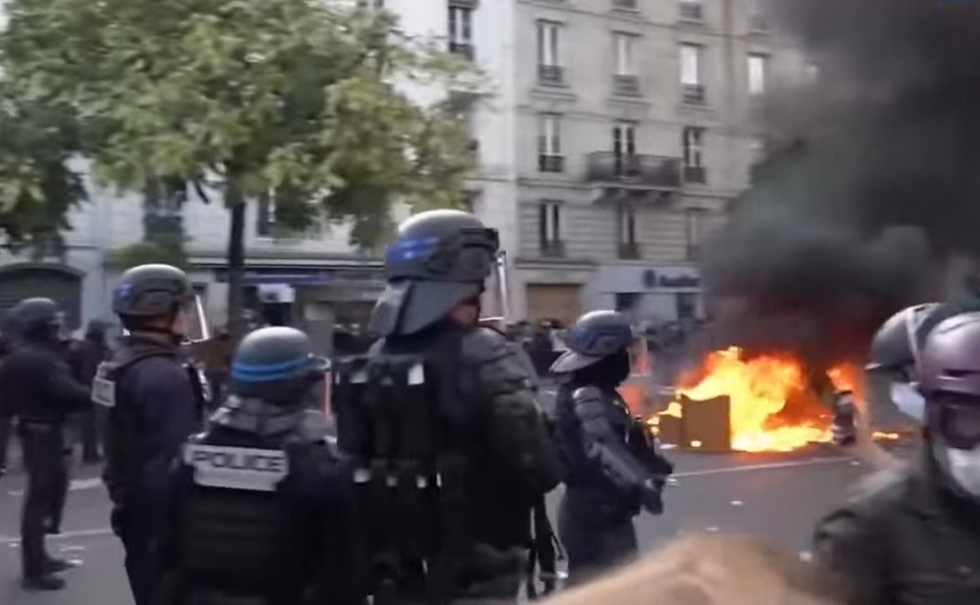
What began as demonstrations reportedly developed into serious disorder in cities including Paris, Lyon, and Limoges. Incidents described in the source accounts included burning police vehicles, attacks on public buildings, smashed shopfronts, and confrontations between demonstrators and law enforcement.
Limoges suffered particularly serious damage when a fire reportedly engulfed its historic town hall, leading to the collapse of the roof. The building had survived two world wars, making the destruction a powerful symbol of the damage civil disorder can inflict on a community's shared heritage. Lyon's tourism office was also reportedly gutted by fire.
In Paris, disturbances included incursions into municipal buildings, clashes near prominent government locations, and the burning of vehicles. Police responded with tear gas and large-scale arrests.
Figures cited in the original accounts placed nationwide participation between 550,000 and 800,000 demonstrators by mid-October. The reports also described extensive injuries among police officers and security personnel.
These developments raise serious questions about public order and the limits of political protest. Citizens have every right to demand better schools, affordable living, and accountable leadership. However, when demonstrations descend into arson, attacks on police, and the destruction of public property, the consequences extend far beyond the original demands. Public institutions, local businesses, taxpayers, and ordinary residents ultimately bear much of the cost.
2. The Political Capture of Protest and the Question of Foreign Influence
The role of organized extremist networks
The unrest in France has also raised questions about who is organizing, directing, and benefiting from the demonstrations. The original investigations described approximately 50 active groups associated with the movement, claiming that only around one-third were genuinely led by students or young people. Other participants reportedly included radical political parties, communist organizations, militant labour unions, and far-left activist groups.
France Unbowed (LFI), a prominent left-wing political party known for its anti-establishment and anti-colonial rhetoric, was among the political actors identified in the accounts. Critics argue that sections of the political left have used student grievances as an opportunity to mobilize broader opposition to President Emmanuel Macron and the existing political order.
From this perspective, the protests are not simply an expression of dissatisfaction with educational policy. They also represent a struggle over political influence, in which organized groups can redirect genuine public anger towards revolutionary objectives.
The concern is that practical issues, such as improving schools or reforming university admissions, may become secondary to a wider campaign against established institutions. When this happens, resolving the original grievances becomes more difficult, while political confrontation takes center stage.
Foreign funding and the “red-green” alliance
The original accounts also point to alleged international financial connections and propaganda networks that amplify images of unrest in Western countries. According to this interpretation, the circulation of dramatic footage and political messaging can help portray democratic governments as incapable of maintaining stability, potentially strengthening hostile narratives abroad.
Another concern is the convergence of far-left socialist or communist groups with radical Islamist and pro-Palestinian factions, a combination sometimes described by critics as the “red-green” alliance. Although these movements may have different ideological foundations, opposition to Western governments and established institutions can provide common ground for cooperation.
The broader argument is that economic dissatisfaction, migrant alienation, and urban disenfranchisement can be exploited by groups whose objectives extend beyond social reform. If organized networks deliberately encourage confrontation and undermine confidence in democratic institutions, the consequences can become a matter of national security rather than ordinary political disagreement.
Such allegations deserve serious investigation, particularly where financial relationships, coordinated propaganda, or direct involvement in violence are suspected. The central question is whether political and international networks are merely participating in public debate or actively using unrest to weaken democratic governments. Establishing the answer requires examining evidence, following financial connections, and identifying who organizes and benefits from the escalation.
3. International Ripples: Unrest Beyond France
The turbulence in France has occurred alongside demonstrations and political confrontations elsewhere, suggesting that economic insecurity and dissatisfaction with government performance are not confined to one country.
In Belgium, Portugal, and Italy, protests linked to economic pressures and solidarity with demonstrators have reportedly taken place. Clashes in Milan illustrate how demonstrations can become confrontational when public frustration intersects with political mobilization.
Albania has experienced a separate wave of unrest in Tirana, where demonstrators gathered outside the education ministry. Reports describe protesters throwing stones and Molotov cocktails at police, who responded with tear gas and water cannons. Anger over alleged government corruption, inadequate educational standards, and difficult economic conditions contributed to the confrontation.
Across the Atlantic, hundreds of students, community members, and French expatriates reportedly assembled at Montreal's Philips Square in solidarity with European protesters. Their concerns included housing affordability, food security, social inequality, and the rising cost of living.
These developments demonstrate how local grievances can resonate internationally. They also show that public confidence in government depends heavily on whether people believe their institutions can provide economic security, deliver essential services, and respond effectively to everyday problems.
4. Scotland: Mass Migration, Housing Shortages, and the Rise of Vigilantism
An overstretched housing and welfare system
In the United Kingdom, the debate has taken a different form, with immigration, housing shortages, and community tensions becoming increasingly intertwined. Glasgow provides a prominent example.
The original accounts describe Glasgow as accommodating a particularly large proportion of asylum seekers and refugees relative to its population. This has occurred against a background of longstanding housing shortages and pressure on homelessness services. In 2023, the city council formally declared a housing and homelessness emergency.
Community organizations, including Homeless Project Scotland, have highlighted the difficulties of assisting vulnerable people when accommodation and support services are already stretched. Meanwhile, residents in disadvantaged neighborhoods point to lengthy housing waiting lists, concerns about public safety, and rapid changes in their communities.
Local authorities have stated that refugees and asylum seekers do not automatically receive priority over other households in public housing allocations. Nevertheless, persistent shortages have fueled perceptions that government policies are failing to balance competing needs.
The central issue is not simply the arrival of migrants but the capacity of public institutions to manage population pressures, provide adequate accommodation, and maintain confidence in the fairness of the system. When governments fail to explain their decisions or deliver visible improvements, resentment can grow and become a source of wider political instability.
Citizen patrols and extremist exploitation
Frustration over public safety and the perceived inadequacy of official responses has reportedly encouraged some Glasgow residents to establish citizen-led patrols, including a group known as Scots Active. Supporters argue that these patrols are necessary to monitor neighborhoods and address concerns that authorities have neglected.
However, the rise of such groups also highlights the risks created when sections of the public lose confidence in formal policing. Informal patrols can intensify confrontation, encourage vigilantism, and provide opportunities for far-right extremists to exploit local grievances.
Reported arson attacks on vacant buildings intended for migrant accommodation, alongside clashes between anti-immigration demonstrators and counter-protesters, underline the seriousness of the situation.
Governments face a difficult but unavoidable responsibility: public concerns about crime, housing, and immigration cannot simply be dismissed, yet vigilantism and politically motivated violence cannot be allowed to replace lawful institutions. Restoring confidence requires effective policing, transparent immigration and housing policies, and visible action against those who threaten public safety.
5. Geopolitical Conflicts and Environmental Pressures
Social unrest is developing alongside international crises that place additional demands on governments and economies.
The conflict in Ukraine, changing approaches to international sanctions, and continuing tensions in the Middle East contribute to uncertainty in global markets. Disruptions affecting shipping through the Strait of Hormuz are particularly significant because instability along major trade routes can influence energy supplies, transport costs, and the prices paid by consumers.
Environmental emergencies add further pressure. The source accounts highlight destructive flash floods associated with mountain rock-and-ice avalanches and wildfires in Southern California intensified by dry conditions and seasonal winds. Such disasters damage infrastructure, displace communities, and require substantial public expenditure.
Canada is also dealing with contentious domestic issues, including provincial debates over regional separation, disputes concerning Indigenous procurement verification, and labour negotiations within the automotive industry.
These developments are distinct rather than necessarily coordinated, but their combined effects can strain government resources and deepen public anxiety. Economic uncertainty, environmental damage, international conflict, and domestic political disputes all test the ability of institutions to maintain stability and public confidence.
Conclusion
The unrest described across France, Albania, Scotland, and Canada reveals the pressures confronting Western democracies. Declining confidence in public institutions, economic hardship, housing shortages, migration-related tensions, and political polarization can reinforce one another, creating conditions in which local grievances escalate into broader confrontations.
The role of organized political movements and alleged foreign influence adds another dimension. When extremist networks exploit legitimate dissatisfaction, amplify social divisions, or encourage violence, the consequences can extend beyond immediate public disorder to the long-term stability of democratic institutions.
Governments must therefore address the underlying problems while maintaining law and order. Better-funded public services, sustainable housing policies, effective migration management, economic security, and accountable administration are essential. Equally important is the willingness to investigate extremist activity and foreign interference where credible evidence exists.
Democracy requires room for peaceful dissent, but it also depends on the protection of public institutions and the rule of law. Recognizing legitimate grievances should not mean overlooking organized violence, just as maintaining public order should not mean ignoring the failures that drive people onto the streets.
Ultimately, the stability of Western societies will depend on whether governments can restore public confidence, enforce the law consistently, and prevent genuine social concerns from becoming instruments of political destabilization.

Comments